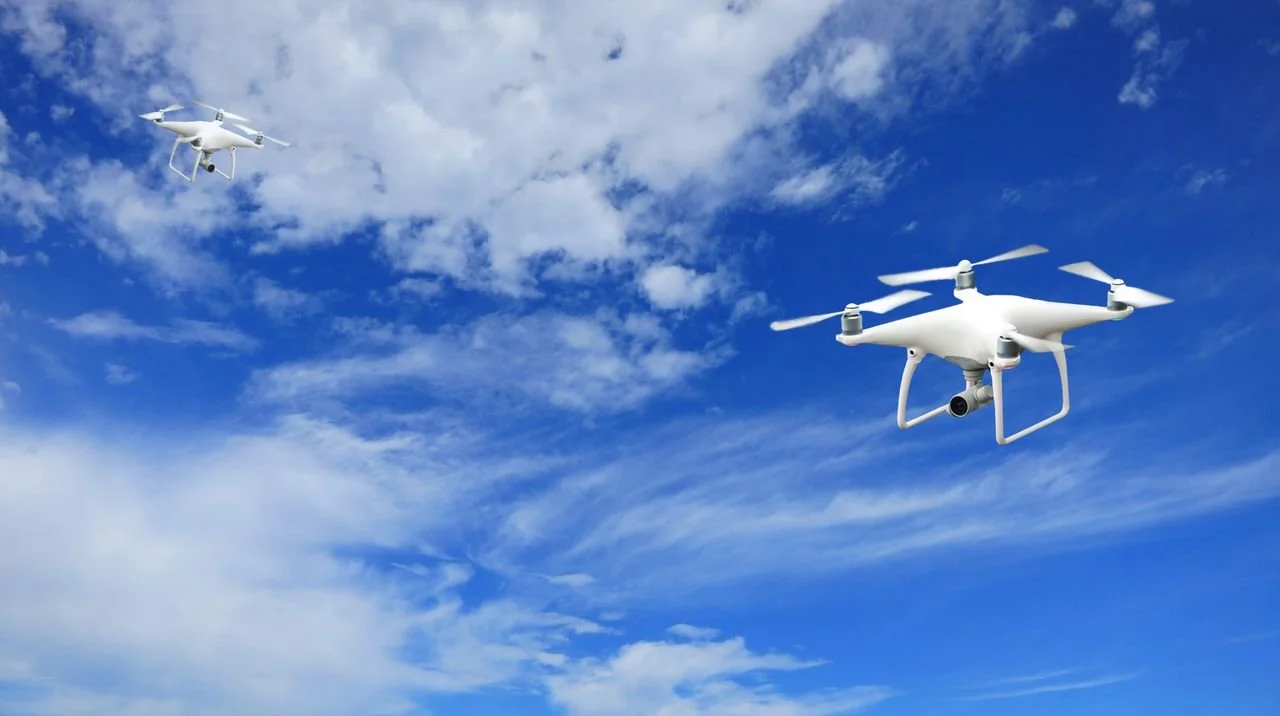
Physical security has long been thought of in two dimensions. Fences, gates, guard posts, and cameras have been designed around a single assumption: that a threat must cross a line on the ground to reach a facility. That assumption no longer holds. Corporate campuses now face a threat that never touches the perimeter at all, because it simply flies over it.
A recent piece from AeroDefense, lays out the problem. Corporate campuses hold enormous amounts of valuable data and intellectual property. Most have invested heavily in the physical and cyber protections needed to keep bad actors out at ground level. What they have not accounted for is the three dimensional challenge that drones introduce. A small, inexpensive quadcopter can now be used for corporate espionage, surveillance of secure areas, and in ways that traditional ground based security simply was not designed to detect.
According to the FAA's Center of Excellence for UAS Research, drone sightings across the country grew by nearly 20 percent in the first three quarters of 2025 compared to the year before, with the highest concentrations in California, Florida, Illinois, Texas, and New York. Writing for Security Management, industry analysts have described drone activity as an accelerating trend in high density and critical infrastructure environments, one that security practitioners can no longer treat as an edge case.
The International Security Journal recently observed that drones are becoming an everyday corporate security problem rather than one confined to major public events and stadiums. The article notes that a drone does not need to enter a building, land on a roof, or carry a payload to create risk. It only needs to observe, record, or appear at the wrong moment, whether that means mapping a logistics yard's delivery schedule or capturing footage of a facility most companies would rather keep private.
Regulators are beginning to respond. In June of 2025, two executive orders directed federal agencies to help the private sector detect, monitor, and respond to unauthorized drone activity, with the FAA tasked with restricting flights over critical infrastructure and the Department of Homeland Security tasked with issuing guidance for facility owners deploying detection systems. New Remote ID requirements are being phased in as well, giving law enforcement more information about who is flying what and where. But as the International Security Journal piece points out, regulation should not be confused with protection. Rules only help when operators comply with them, and plenty of the drones that matter most to security teams belong to people who have no intention of doing so.
For corporate security leaders, the response must mirror what already happened at the ground level a generation ago: layered, technology enabled detection paired with a clear plan for what happens next. That increasingly means radar and RF detection systems that can flag an unauthorized aircraft the moment it enters a campus's airspace, paired with protocols for verifying intent and, where legally permitted, responding. Just as important is treating the airspace above a facility as a formal part of the risk assessment rather than an afterthought bolted on after an incident occurs.
The perimeter fence was never meant to protect a building from the sky. As drones become cheaper, more capable, and more common, corporate campuses that continue to plan security in two dimensions will find themselves defending only half the problem.